Tempted by the invitation from our hosts, the Mountaineering Club “Tetova,” to join the event “Winter Hike through the Leshnica Valley and Waterfalls”, we decided to take part in this adventure—just like our fellow mountaineers from “Kastrioti” Club in Ferizaj, Kosovo.
The meeting point was set at the former cable car station, which once connected Tetova to the Popova Shapka ski center (Kodra e Diellit) through modest but reliable gondolas. Unfortunately, this vital infrastructure ceased operating during the armed conflict in 2001. For the past 22 years, this once-important asset of Tetova has remained nothing more than a useless relic.
Ironically, this very location is now the regular gathering point for weekend hikes. It’s as if we want to remind ourselves of a time when we could entirely avoid using cars to reach the mountains. Today, we can only stand outside the fenced-off structure, looking in with nostalgia—and a bit of regret—for what we’ve lost.
Consolidation of the group
Within a few minutes, the group begins to come together. A 4×4 parks nearby, and out steps “The Trio”—as they’ve been known for years—the inseparable friends and mountaineers: Dr. Rexhep, recipient of the Xhambazov Award (the highest honor given by the Mountaineering Federation of North Macedonia), President Sejdiu, and Treasurer Naser.
One after another, more members arrive: the group of Secretary Bujar, joined by Florent, Agim, Rufat, and others in succession. A new face draws the curiosity of the club members—it’s Besar, capturing the moment with a camera that looks quite professional. He joins the group with enthusiasm, hoping to capture some unique shots of Leshnica, inspired by the vivid descriptions shared by the others.
On the other side, Qenan brings unfortunate news: due to technical reasons, our guests from Kosovo won’t be able to join us, as informed by the leader of the “Kastrioti” group.
The beginning of the journey from the foot of Sharr towards the Tetovo Highlands
After the usual greetings among members—and despite the disappointment over the absence of our guests—the group sets off in five vehicles toward the Tetova Highlands, aiming to reach the last village on this side of the mountain, the village of Bozovce.
The road stretches nearly 22 kilometers and takes us around 50 minutes to reach our final destination. Upon arrival, we park the vehicles and exchange greetings with the locals, who, as always, welcome us with warmth and hospitality.
Towards the Queen of Sharr
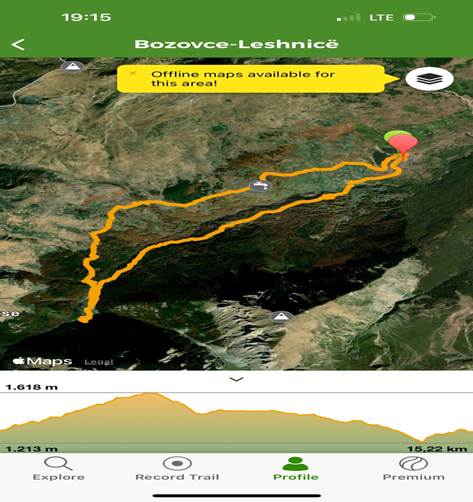
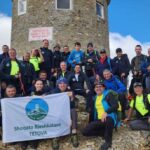
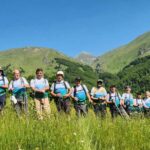
After we finish putting on our hiking boots, snow guards, and adjusting our hiking poles, we group up near the village elementary school. The group leader informs us that the trail is about 18-19 kilometers long in both directions and that we will climb up from the upper trail and return from the lower trail. The guide for this trip is Musli, born in Bozovcë, but moved to Tetovo many years ago, but who happily leads us to this pearl of his birthplace. At the beginning of the trail, at Rudina as the locals call it, we take the first group photo and continue hiking. We take our first break at a fairly well-arranged point, with benches to rest, a water tap, and a small shelter, which can serve us in case of rain. The guide informs us that the next break will be at Gajrinat. On the way to Gajrina, a powerful and stubborn stream appears, cutting the road right in the middle, from the numerous water flows, as if to show us that from here on begins the area where wild nature and not man prevails. The residents of the area have built a wooden bridge, which makes a natural mix for photo-session with the stream and which undoubtedly facilitates the movement of the many tourists.
The second stop comes at “Gajrina të Poshtme” and this is one of the most picturesque points of this side. On our right, a small lake appears, which adds even more charm to this hill. On the left, Maja e Ortegut (Upper Plat) proudly pierces the sky, and below it in the forest, the Lake appears that is created only during winter and spring, from the melting of snow. Next comes Guri i Mesëm (or Kepi i Nërmjem as the locals call it) that stands as a guardian of the Leshnica Valley and after it Kepi i Tretë ( Kepi i Përtijm ). Continuing on the right side, we see: Maja e Brodit, Babahasanajca, Gjuri i Lodras, and a little below it comes Gjuri i Çamë (i çarë), and below it comes the toponym called Vorri i Shehit (Shehut’s Tomb) and Gajrinat e Epërme.
After a short break in Gajrina të Poshtme, we continue our walk towards Leshnica. As soon as the tall pine trees appear, we realize that we are entering the territory of the Leshnica Valley. As we descend into the Valley, the rushing Leshnica River awaits our path, as if to reprimand us for how we once abandoned it, without protection, when the hydromafia obtained permission to appropriate this pearl. And yet, thanks to the declaration of the Sharr Mountain as a National Park, this decision was repealed and the steel pipes remain as evidence of a shame that the Sharr mountaineers silently swallowed at that time, without trying to master this area, which is known as the most beautiful area of the Sharr massif.
We cross the river on a wooden bridge , built by villagers and people of goodwill, with great finesse, and in harmony with the surrounding environment. As soon as we cross to the other side, after a short walk along the river, a wooden sign appears in front of us informing us that we are in the Sharr Mountain National Park, accompanied by an orientation map. After it, we cross a part of the river over the Tetova water pipe that serves as an improvised bridge and we reach the famous pine trees of Leshnica. This place is quite popular for camping by foreign tourists and locals, since the view is quite beautiful and relaxing, there is drinking water in the form of a tap nearby (although the river itself is drinkable) and during the summer the pine trees serve as a shield from the strong sun. After the pine trees come the villas of former communist officials who once enjoyed this pearl of Sharr alone and the area was strictly forbidden to others. The group leader informs us that we will stop here for the next break, and some mountaineers are collecting dry wood that is found around, while another group is trying to light a fire. This break was also used to eat the modest lunch that everyone had brought with them, but which they very kindly share with others, and was also used to relax under the accompaniment of Dr. Rexhepi’s barcolets.
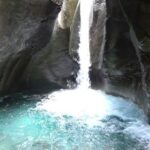
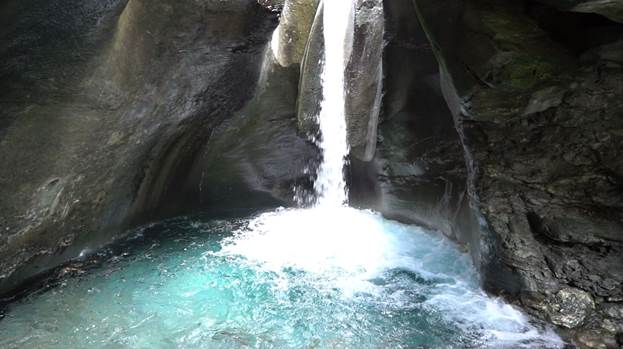
We continue our walk towards the Leshnica Waterfall, where after a short path in the dense forests of Leshnica, wooden stairs appear in front of us that lead to a rock that resembles a cave. Inside it hides one of the masterpieces of this area, the Leshnica Waterfall. Although the waterfall is not very high, its characteristic shape, the fast and cold flow of water that has carved the rocks into a very interesting shape, makes this waterfall quite unique and attractive for tourists. Someone asks with great curiosity “Where does all this crystal water go?” and Bujar answers in the best possible way by bending down, filling his hands with water and drinking with pleasure, “Eheee, this spring supplies almost all of Tetovo with water”.
We return by the lower path, which is entirely through the woods, and which, due to the terrain, is even more suitable for descending. Here, Professor Nasufi finds the opportunity to explain to us about one of the most characteristic trees of this area, which is unfortunately also one of the endangered species, the Taisi or Tisa as it is known by the inhabitants of the area, or Taxus baccata in Latin. The main characteristic of this type of wood is that it is very difficult to cut, but even more difficult to rot, which makes it suitable for use in the fences of houses in the area, due to its durability.
Upon reaching the village, we rest for the last time in a cafe and return to our starting point, from where we continue our journey to the city of Tetova, leaving behind Bozovca and the Leshnica Valley, this pearl of the Sharr that is renewed and becomes even more beautiful in every season.
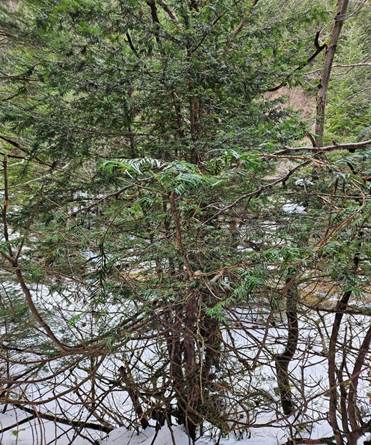
Photo: Tajsi or Tisa ( lat: Taxus baccata )